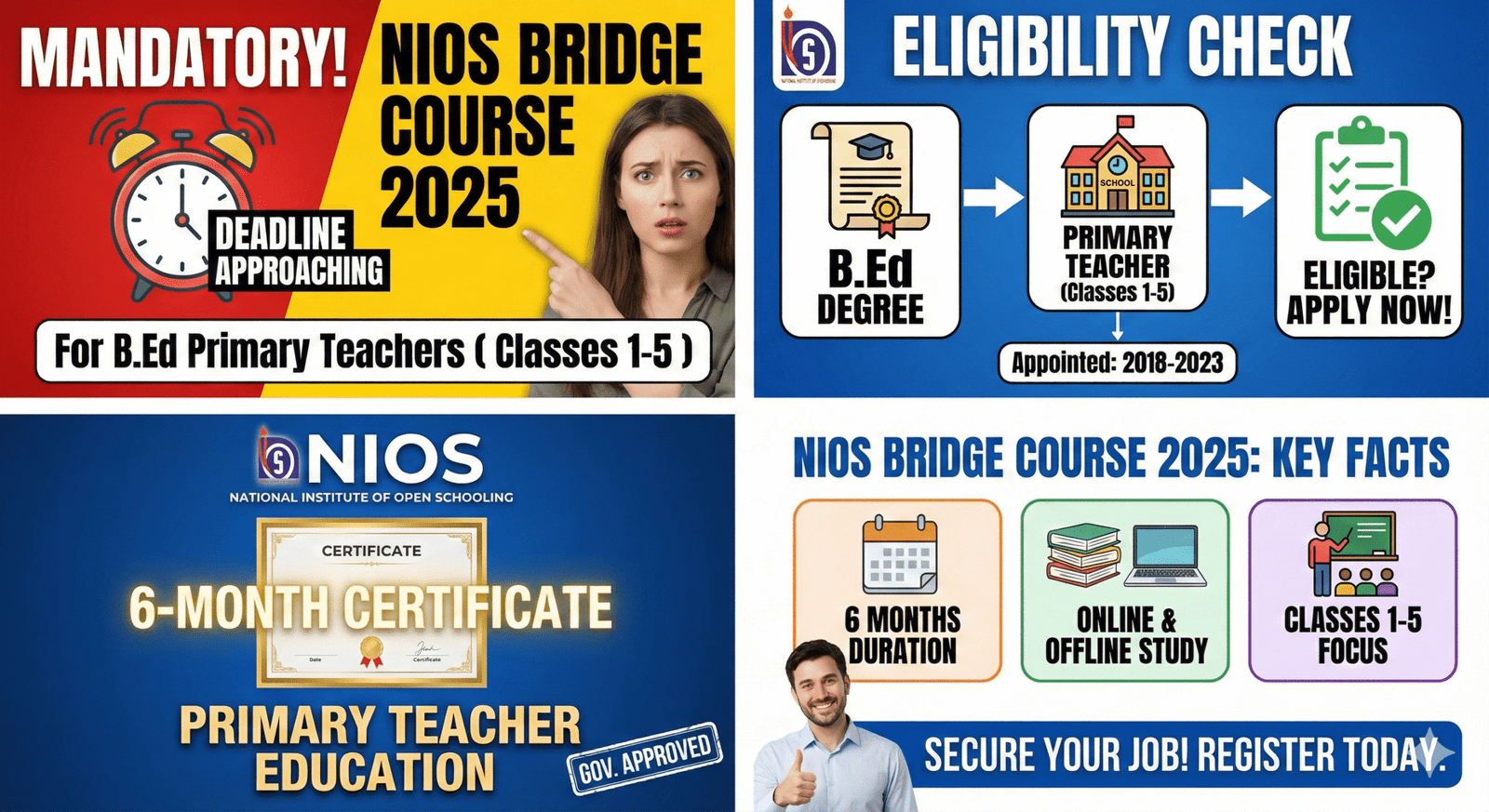
NIOS Bridge Course 2025 for B.Ed Primary Teachers
NIOS Bridge Course 2025 is a mandatory six‑month certificate programme in Primary Teacher Education for B.Ed‑qualified primary teachers appointed in Classes 1–5 between 28 June 2018 and 11 August 2023, aimed at protecting their eligibility under updated NCTE and Supreme Court norms. Registration is being conducted online through the dedicated portal bridge.nios.ac.in as per the latest NIOS notifications.
Government jobs and NIOS Bridge Course
Government teaching jobs in India continue to attract lakhs of aspirants due to job security, regular pay scales, pension benefits, and the social respect attached to the teacher’s role in public schools. The NIOS Bridge Course acts as a crucial academic bridge, ensuring that B.Ed‑qualified primary teachers meet revised legal and pedagogical norms and can continue in their government or aided school posts without interruption.
From an academic perspective, this six‑month certificate can be viewed as a specialised genre of professional development, where the central theme is alignment between teacher qualification, child‑centred pedagogy, and legal compliance in the post‑2018–2023 time period. Much like doing a focused character analysis of the primary teacher’s role, the course revisits key concepts of elementary education, classroom management, symbolism in child development materials, and inclusive assessment practices.
What is the NIOS Bridge Course?
- Official Name: Six‑Months Certificate (Bridge) Course in Primary Teacher Education (through NIOS).
- Duration: 6 months (certificate course through distance/online mode with some school‑based activities).
- Conducting Body: National Institute of Open Schooling (NIOS), under Ministry of Education, Government of India.
- Regulatory Basis: Designed as per NCTE directions following Supreme Court orders on B.Ed‑qualified primary teachers.
The primary theme of the course is to bridge the gap between a B.Ed graduate’s training (largely focused on upper classes) and the specific pedagogical needs of Classes 1–5. In curriculum terms, the “protagonist” is the in‑service primary teacher, and the syllabus tracks their journey from generic B.Ed learning to specialised child‑centred elementary teaching.
Eligibility criteria
Only a specific band of in‑service B.Ed teachers is allowed to join this NIOS Bridge Course.
- Must hold a valid B.Ed degree from a recognised university.
- Must be appointed as Primary Teacher for Classes 1–5.
- Date of appointment must fall between 28 June 2018 and 11 August 2023 (both dates inclusive).
- Appointment should be in a recognised school (government, government‑aided, or as per state orders), generally tagged with a valid U‑DISE Plus school code.
- Teachers already holding BTC, D.El.Ed, or equivalent elementary teacher education qualifications are typically not required/eligible for this bridge course.
Eligibility snapshot table
| Parameter | Requirement |
|---|---|
| Academic Degree | B.Ed from recognised institution/university. |
| Teaching Level | In‑service Primary Teacher (Classes I–V). |
| Appointment Window | Between 28 June 2018 and 11 August 2023. |
| School Type | Recognised school with U‑DISE Plus code (Govt/Govt‑aided/approved). |
| Excluded Categories | Those already qualified with BTC/D.El.Ed‑type elementary courses. |
Important dates (2025 cycle)
As per the current 2025 registration cycle, the portal for the six‑month Bridge Course has been opened with clear start and end dates.
NIOS Bridge Course 2025 – Important dates
| Event | Date / Period (2025) |
|---|---|
| Registration portal launch | 24 November 2025 onwards. |
| Online registration start date | 24 November 2025. |
| Last date to register | 25 December 2025. |
| Course duration | Six months from batch commencement. |
| Tentative examination window | After completion of six‑month coursework (as scheduled by NIOS). |
Exact exam dates and batch‑wise schedules may be notified separately by NIOS, so candidates should regularly check official links.nios+1
Course structure, syllabus and major themes
Though detailed syllabus PDFs are hosted by NIOS, public summaries indicate that the Bridge Course focuses on foundational primary‑education pedagogy.
Key academic themes commonly covered:
- Child development and psychology for early grades (symbolism in children’s drawings, stories, and play).
- Pedagogy of language, mathematics, and environmental studies for Classes 1–5.
- Inclusive education, classroom management, assessment, and reflective teaching practice.
- School‑based experience, project work, and assignments related to real classroom situations (similar to extended character analysis of teacher–student interactions).
From an academic‑writing perspective, modules often use case studies, narrative episodes, and classroom “scenes” that can be analysed the way a critic interprets narrative structure or point of view in a literary text. This narrative approach deepens teachers’ understanding of classroom symbolism, implicit biases, and the power dynamics of teacher–pupil relationships.
Application fee and mode
State‑wise or notification‑wise fee details may vary slightly, but in most cases:
- Application/registration is done online only through the official bridge.nios.ac.in portal.
- The fee is paid digitally (net banking, debit/credit card, UPI, etc.) during the registration process.
Teachers should cross‑check the exact fee amount, concession rules (if any), and payment deadlines in the latest NIOS or state education department circular/notification.
Selection and certification process
The Bridge Course is not a competitive “selection” exam in the usual sense, but successful completion is mandatory for retaining eligibility.
Typical process:
- Admission based on fulfilment of eligibility criteria and correct document upload (no merit list in most cases).
- Completion of assignments, project work, and school‑based activities as per NIOS guidelines.
- Appearance in theory examinations/assessments scheduled after the six‑month teaching‑learning period.
- Award of Six‑Month Certificate (Bridge Course in Primary Teacher Education) by NIOS on passing all required components.
This certificate functions as a crucial “plot resolution” in the teacher’s professional story—without it, the character arc (teacher’s appointment) may remain legally incomplete.
How to apply online (step‑by‑step)
Below is a generic step sequence based on current portal workflows; candidates must still follow the exact on‑screen instructions.
- Open the official Bridge Course portal: bridge.nios.ac.in.
- Click on “Registration/Login” and choose “New Registration” for first‑time users.
- Enter basic details: name, mobile number, email, date of birth, and create a password.
- Fill in teaching and appointment details: B.Ed qualification, appointment date, post, school name, U‑DISE Plus code, state, district.
- Upload scanned documents in the prescribed format:
- B.Ed degree certificate/mark sheets.
- Appointment letter as primary teacher.
- Self‑declaration certificate in the prescribed format, signed by the head of school/principal.
- Recent passport‑size photograph and signature.
- Select preferred study centre/region if the portal asks for it.
- Pay the application fee online and confirm the form.
- Download and save the confirmation page and print a copy for future reference.
In narrative terms, think of the application process as an organised exposition: each detail (document, date, number) is a symbol of your eligibility that must be correctly “placed” in the story for a satisfying outcome.
Documents required
- B.Ed degree/mark sheet from recognised university.
- Appointment letter as primary teacher (Classes I–V) dated between 28 June 2018 and 11 August 2023.
- School’s U‑DISE Plus code and details.
- Self‑declaration certificate as per NIOS format, authenticated by school head.
- Recent passport‑size photo and specimen signature (scanned).youtube
- Any additional documents required by specific state circulars (if mentioned).
Preparation tips (academic and practical)
To “pass” the Bridge Course with strong performance, treating it like a serious academic text helps.
- Read the official study material carefully
- Approach each unit like a literary text: identify its central theme, key arguments, and implied symbolism about childhood and learning.
- Highlight concepts related to inclusive classroom practice, multi‑level teaching, and formative assessment, and make short notes in your own words.
- Integrate theory with your day‑to‑day classroom
- For every theoretical chapter, write a mini character analysis of one learner or a small group in your real class, connecting concepts like motivation, attention span, and learning style.unnatieducations
- Keep a reflective teaching diary, noting what strategies worked, which did not, and how you adjusted your “plot” (lesson plan) for better engagement.unnatieducations
- Practice assignment writing as structured academic prose
- Follow a clear introduction–body–conclusion format, use headings and sub‑headings, and support points with classroom examples instead of copying material.youtubeunnatieducations
- Use academic terms such as “child‑centred pedagogy”, “constructivist approach”, “symbolism in visual teaching aids”, and “critical reflection” naturally in your explanations.unnatieducations
- Prepare systematically for the final assessment
- Revise unit‑wise using mind maps and bullet‑point summaries, paying attention to definitions, case examples, and policy references.gullybaba+1
- Attempt previous‑pattern questions and mock tests if available from trusted academic sources, and time yourself to improve speed and accuracy.youtubeunnatieducations
Useful official links (with styling guidance)
Below is a table of key official links and sources that you can highlight in your post. On Sarkareeresult.com you can easily apply bold styling and coloured buttons using your theme or basic HTML/CSS.
| Link Type | Description | Official URL |
|---|---|---|
| NIOS Official Website | Main portal for all NIOS notifications, circulars, and courses.nios | https://www.nios.ac.in http://dledbr.nios.ac.in/ |
| Bridge Course Registration Portal | Dedicated portal for Six‑Month Bridge Course registration.shiksha+1 | https://bridge.nios.ac. |
| NIOS Bridge Course Notification 07/2025 | Launch of registration portal for 6‑Month Bridge Course (Primary Teacher Education).nios | Notification section at NIOS |
| NCTE Public Notice (Bridge Course) | NCTE public notice detailing six‑month bridge course for B.Ed primary teachers.ncte | NCTE official website (public notices)ncte |
| News Article – Registration Open | Media coverage summarising eligibility, dates, and process.shiksha+1 | Major education portals (e.g., Jagranjosh, Shiksha)shiksha |
On your site you can wrap each URL in colourful buttons like <a class="btn btn-success"> or custom CSS to make the Useful Links section visually prominent, while keeping the text SEO‑friendly and accessible.
SEO notes and keyword integration
For Sarkareeresult.com, you can weave in additional academic and exam‑oriented keywords naturally throughout the article, for example:
- “NIOS Bridge Course syllabus analysis for B.Ed primary teachers”
- “time period 2018–2023 appointments and Supreme Court directions on eligibility”
- “major theme of the Bridge Course is alignment of legal norms and child‑centred pedagogy”
- “symbolism of classroom activities in early‑grade learning material”
- “character analysis of the ideal primary teacher in the Indian government school system”
These phrases blend government‑job content with academic vocabulary (symbolism, character analysis, narrative, genre, theme) without keyword stuffing, supporting both exam‑oriented readers and education researchers.
FAQ – NIOS Bridge Course 2025
Q1. What is the NIOS Bridge Course for B.Ed teachers?
It is a six‑month certificate course in Primary Teacher Education conducted by NIOS to regularise the eligibility of B.Ed‑qualified primary teachers appointed in Classes 1–5.shiksha+1
Q2. Who must compulsorily do this Bridge Course?
All B.Ed degree holders appointed as primary teachers (Classes I–V) between 28 June 2018 and 11 August 2023 are required to complete this course to maintain their eligibility.shiksha+1
Q3. Is the course online or offline?
The course is primarily delivered through distance/online mode, with online resources and assignments, along with some school‑based activities and practical components.unnatieducations
Q4. How can I apply for the NIOS Bridge Course 2025?
Eligible teachers must register online at bridge.nios.ac.in, fill in their personal and appointment details, upload required documents, pay the fee, and download the confirmation page.nios+1youtube
Q5. What happens if I do not complete the Bridge Course?
Non‑completion may affect the validity of your appointment as a primary teacher, because the Bridge Course is mandated to align B.Ed qualifications with NCTE and Supreme Court guidelines.shiksha+1
Q6. Are BTC or D.El.Ed‑qualified teachers required to do this course?
No. The course is primarily meant for B.Ed‑qualified teachers teaching at the primary level; those already holding recognised elementary education diplomas usually do not need it.unnatieducations
Q7. Does the Bridge Course certificate help in future government job promotions?
While promotion rules vary by state and service rules, the certificate strongly supports your continued eligibility at the primary level and can strengthen your professional development profile.shiksha+1
Q8. Where can I check latest updates and detailed notifications?
Always refer to the official NIOS website (nios.ac.in), the Bridge Course portal (bridge.nios.ac.in), and NCTE/State Education Department notices for the latest circulars and updates.
Pingback: UPPSC Recruitment 2025: Various Gazetted Posts & Technical Education Teaching Service - Sarkareeresult.com