Government Degree College Assistant Professor Examination 2025
UPPSC Assistant Professor Recruitment 2025: 1253 Vacancies in Government Degree Colleges. UPPSC (Uttar Pradesh Public Service Commission) has officially released the notification for Assistant Professor Recruitment 2025 for Government Degree Colleges, inviting applications to fill 1253 posts across multiple disciplines in Uttar Pradesh. This is a prestigious opportunity for those aspiring to build a career in higher education.

Organization & Post Details
- Organization Name: Uttar Pradesh Public Service Commission (UPPSC)
- Post Name: Assistant Professor, Government Degree College
- Advertisement No.: A-7/E-1/2025
- Total Vacancies: 1253.
- Job Location: Uttar Pradesh
- Apply Mode: Online only
Important Dates
| Event | Date |
|---|---|
| Notification Release Date | 4th Sep 2025 |
| Start of Online Application | 4th Sep 2025 |
| Last Date for Application & Fee Payment | 6th Oct 2025 |
| Last Date for Correction/Modification | 13th Oct 2025 |
Age Limit (as on 01/07/2025)
- Minimum Age: 21 Years
- Maximum Age: 40 Years
- Must Not be Born Before: 2nd July 1985
- Must Not be Born After: 1st July 2004
- Age Relaxation (as per rules):
- SC/ST/OBC of U.P.: +5 years
- PwBD: +15 years
- State Govt. Employees: +5 years
- Ex-Servicemen/ECO/SSCO: Service period + 3 years
Educational Qualification
- Master’s Degree (with at least 55% marks, 50% for reserved categories) in relevant subject from a recognized University.
- UGC NET Qualified or Ph.D. as per UGC regulations
- For subject-wise qualifications, refer to the official notification
Application Fee
| Category | Fee (in ₹) |
|---|---|
| General/OBC/EWS | 125 |
| SC/ST/PWD | 65 |
| Mode of Payment | Online (Debit/Credit Card, Net Banking, UPI) |
Selection Process
- Written Examination
- Interview
- Candidates must qualify in the written test to be called for the interview
How to Apply
- One Time Registration (OTR):
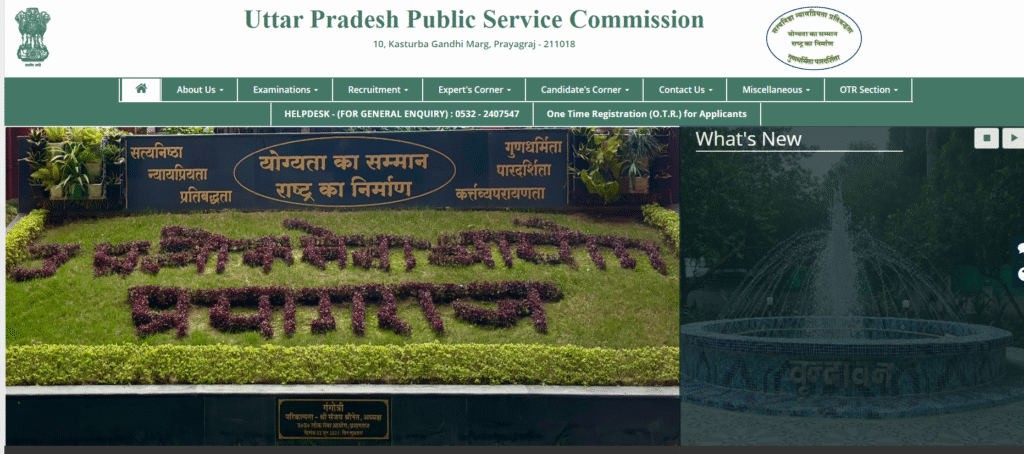
- Go to UPPSC Official Website
- Click on “One Time Registration (OTR)” and fill personal/academic details to generate OTR ID
- Fill Online Application:
- Log in with your OTR ID
- Select “Assistant Professor, Government Degree College Examination-2025”
- Fill all required details (qualification, reservation category, etc.)
- Document Upload:
- Upload scanned copies of photo & signature and necessary certificates
- Pay Application Fee:
- Pay as per your category through available online options
- Final Submission:
- Review and submit. Take a print of the confirmation page
Vacancy Table (Sample Subjects)
| Subject | No. of Posts |
|---|---|
| Botany | 79 |
| Chemistry | 87 |
| Commerce | 157 |
| Hindi | 87 |
| English | 92 |
| Sociology | 78 |
| Political Science | 57 |
| Physical Education | 59 |
| History | 58 |
| Mathematics | 79 |
| Physics | 60 |
| Computer Science | 1 |
| Statistics | 2 |
| Others (Arts, Music) | Multiple |
Useful Links Table
| Action | Link |
|---|---|
| Official Website | UPPSC Official Website |
| Apply Online | Direct Application Link |
| Registration | One Time Registration |
| Notification PDF | Download Notification Hindi – English |
Subject-wise Detailed Syllabus Summary
Botany
- Molecules and their biological interactions
- Cellular organization, fundamental processes
- Cell communication, signaling, biosynthesis
- Genetics, taxonomy, evolution, ecology, applied biology
- Molecular biology and recombinant DNA technology
- Biophysical methods, microscopy, statistical methods in biology
Chemistry
- Inorganic Chemistry: Elements, Coordination compounds, Spectroscopy
- Organic Chemistry: Mechanisms, stereochemistry, common named reactions
- Physical Chemistry: Quantum mechanics, thermodynamics, kinetics
- Chemical Analysis and spectroscopy techniques
Commerce
- Accounting and finance principles, corporate accounting
- Statistics and research methodology in commerce
- Marketing concepts and consumer behavior
- Human resource management and organizational behavior
- Business economics and environment
Education
- Philosophical, sociological foundations of education
- History, politics, economics in education
- Curriculum studies, pedagogy, and assessment
- Educational technology, management, administration
- Inclusive education and teacher education models
English Literature
- Poetry: Chaucer, Donne, Milton, Wordsworth, Keats, Shelley, Tennyson, Browning, Arnold, Eliot, Yeats, Heaney, Larkin, Hughes
- Drama: Shakespeare, Webster, Johnson, Beckett, Pinter, Miller
- Fiction and Prose: Dickens, Hardy, Conrad, Joyce, Woolf, Lawrence, Golding
- Literary Theory, Criticism, Linguistics, Translation Studies
Economics
- Micro & Macro Economics: Theories, equilibrium, demand, supply
- Money, Banking, Fiscal Policy, Public Finance
- International trade and economic development theories
- Indian Economy, growth, development, environmental challenges
- Quantitative and mathematical techniques in economics
Geography
- Geomorphology, Climatology, Oceanography
- Environment and Ecology, Population and Settlement
- Agricultural, Industrial Geography
- Regional Development, Political & Cultural Geography
- Geographic Techniques: GIS, Remote sensing, Cartography
History
- Prehistoric to Medieval India: Civilization, empires, socio-political structures
- Mughal Empire, regional kingdoms
- British colonial rule, nationalist movements, post-independence challenges
- Historical methodology, sources, and historiography
Home Science
- Human development, prenatal stages, developmental tasks
- Food science, processing, packaging, safety
- Nutrition through life stages, clinical nutrition
- Family resource management, textile science, apparel design
- Extension education, research methods
Mathematics
- Algebra: Groups, rings, fields, modules
- Linear algebra, complex analysis, topology
- Differential equations and numerical methods
- Vector calculus, mechanics, quantum mechanics
- Statistics, probability, graph theory, operations research
Physics
- Mathematical physics fundamentals
- Classical mechanics, quantum mechanics
- Electromagnetic theory
- Thermodynamics, statistical physics
- Electronics, atomic and molecular physics
- Nuclear and particle physics, solid-state physics
Political Science
- Political theory, ideologies, state and governance
- Indian constitution, national movement, political processes
- International relations and diplomacy
- Public administration and organizational theory
Psychology
- Theoretical approaches, cognitive neuropsychology
- Reasoning, decision making, problem solving
- Personality, intelligence, motivation, emotion
- Research methods, experimental design, statistics
- Clinical psychology, counseling, social psychology
Sociology
- Sociological concepts, social processes
- Classical and contemporary sociological theories
- Social change, Indian society, caste, family, gender issues
- Research methodology and contemporary social issues
Urdu
- Origin and development of Urdu language and literature
- Poetry (Ghazal, Qasidah, Masnavi, Marsiya, Nazm, Rubayi)
- Prose forms: Biography, essay, travelogue, letter writing
- Drama and literary criticism
- Media and mass communication
Zoology
- Non-chordates, chordates and their physiology
- Ecology, animal behavior, evolution
- Entomology, fish and fisheries
- Developmental biology, cell physiology, immunology
- Modern molecular biology techniques
Computer Science
- Computer arithmetic, discrete structures, data structures
- Algorithm design and analysis, object orientation
- Database management, operating systems
- Theory of computation, artificial intelligence
- Data communication, networking, security
- Software engineering and web technology
Statistics
- Probability theory, distribution theory
- Estimation, hypothesis testing, regression analysis
- Sampling techniques, design of experiments
- Multivariate analysis, quality control, time series
- Vital statistics and Indian official statistics
Music (Vocal and Instrumental)
- Theory and practice of ragas, taals, and compositions
- History and development of Indian classical music
- Study of musical instruments and gharanas
- Comparative study of Hindustani and Karnatak music
- Performance and stage presentation
Persian
- Origin, grammar, and literary history
- Indo-Persian prose and poetry
- Critical and biographical studies of poets and authors
- Translation of classical Persian texts
Physical Education
- Principles and history of physical education
- Exercise physiology, sports injuries, kinesiology
- Sports psychology, competition, and management
- Test, measurement, and evaluation in physical education
- Curriculum development and research methods
Drawing & Painting
- Fundamentals of art, principles, and elements
- History of Indian and Western painting
- Folk, tribal, and modern Indian art
- Sculpture and architecture
Military Science
- Defence and strategic studies, warfare evolution
- Economic aspects of war, national security concepts
- Strategic thought and science & technology in warfare
- Non-traditional security threats, weapons of mass destruction
Philosophy
- Indian and Western philosophy, ethics, logic
- Philosophy of religion and world religions
- Contemporary Indian and Western philosophy
- Socio-political philosophy, applied and professional ethics
This summary covers the main subjects and units included in the full syllabus document provided. The syllabus is very extensive and structured in a detailed academic format for the Assistant Professor examination.
Frequently Asked Questions (FAQ)
Q1. What is the total number of vacancies for UPPSC Assistant Professor 2025?
A: There are 1253 vacancies in Government Degree Colleges.
Q2. What is the application last date?
A: The last date for online application is 6th October 2025.
Q3. What is the age limit for UPPSC Assistant Professor post?
A: 21 to 40 years; age relaxation applicable for reserved categories.
Q4. What are the educational qualifications required?
A: Master’s with 55% marks (50% for reserved), and UGC NET/Ph.D. in relevant subject.
Q5. What is the application fee?
A: General/OBC/EWS: ₹125; SC/ST/PWD: ₹65.
Q6. Is One Time Registration (OTR) mandatory?
A: Yes, candidates must register on OTR before filling the application form.
Q7. How will the selection process be conducted?
A: Through written examination followed by interview.
Q8. Where can I apply online?
A: Visit https://uppsc.up.nic.in and follow instructions.
Q9. Can I make corrections after submitting the form?
A: Yes, you can modify/correct till 13th October 2025.


Pingback: UPPSC Assistant Prosecution Officer Recruitment 2025 - Sarkareeresult.com